Compact Home Saunas for Small Spaces: 2026 Picks
Table of Contents
- Comparing the Best Compact Home Saunas for Small Spaces
- What to Check Before You Buy a Small Home Sauna
- Home Sauna Electrical Requirements: What Your Panel Can Handle
- Traditional vs Infrared Sauna for Small Spaces
- Infrared Sauna Benefits for Recovery
- Moisture, Ventilation, and Long-Term Maintenance
- Used Saunas and Smart Home Add-Ons: What to Know
- Conclusion
- Frequently Asked Questions
Last Updated: September 16, 2026
Comparing the Best Compact Home Saunas for Small Spaces
A compact home sauna is a scaled-down sauna built to fit into a spare corner, closet, or home gym without giving up the heat experience. The best compact home saunas for small spaces in 2026 balance three things: a footprint under about 32 inches wide, a power draw your home can support, and a heating system that warms up fast enough that you'll use it daily.
Here's the short version before the details:
| Model | Footprint | Power | Best For | Price |
|---|---|---|---|---|
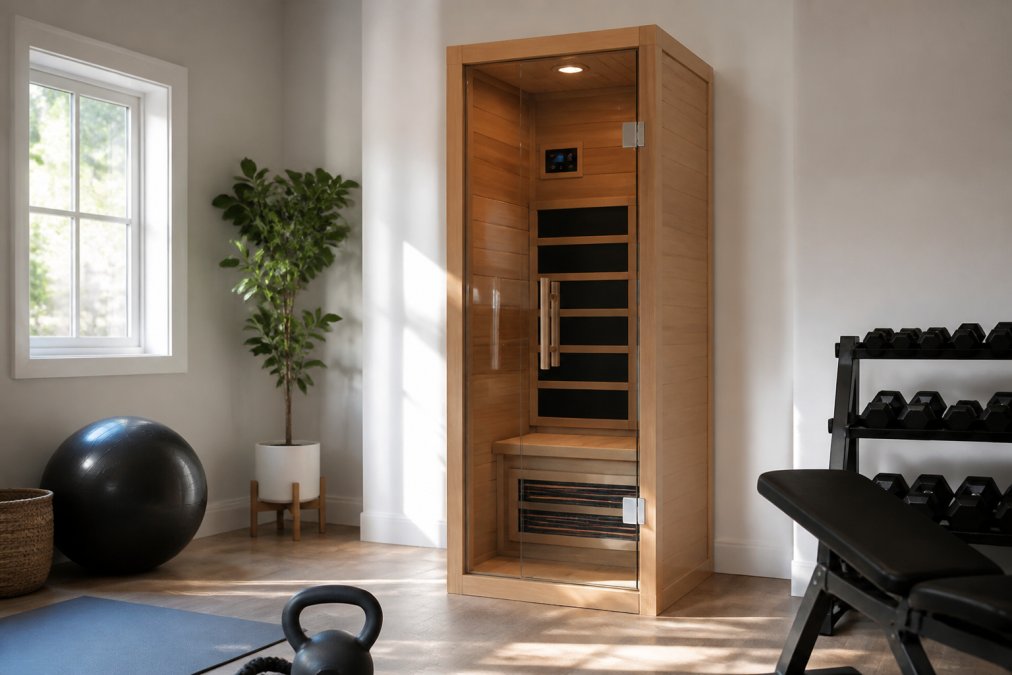
| 1-Person Full-Spectrum Infrared Sauna | 31.5 x 30.3 x 67 in. | 1290W, 120V | Apartments and condos | $1,645.66 |
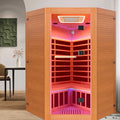
| 2-3 Person Indoor Infrared Sauna | Pentagonal corner | 2180W, 110V | Couples, corner spaces | $2,877.81 |
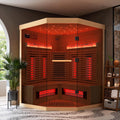
| 3-4 Person Corner Infrared Sauna | Corner | 220V | Family use, salt therapy | $2,845.66 |
What to Check Before You Buy a Small Home Sauna
The three specs that decide whether a compact sauna works in your space are footprint, wood type, and heater placement. Get these wrong and you're either returning a crate or staring at a sauna you never turn on.

Footprint and Dimensions
Measure the actual floor space, not the wall space. A 1-person unit at 31.5 x 30.3 inches needs a clear square roughly the size of a large armchair, plus door swing clearance. Corner designs, like the pentagonal 2-3 person model, trade interior room for a shape that tucks into dead space.

Wood Type and Build Quality
Canadian hemlock and cedar are the two woods you'll see most in quality compact saunas. Hemlock holds up in the humid interior of an infrared cabin and stays affordable; cedar resists moisture and carries a natural aroma many associate with traditional saunas.
Home Sauna Electrical Requirements: What Your Panel Can Handle
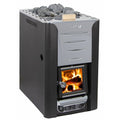
Home sauna electrical requirements come down to two numbers: voltage and amperage. Infrared saunas for small spaces run on either a standard 120V household circuit or a dedicated 220-240V line installed by an electrician. The 1-person full-spectrum unit uses 120V at 1290W and plugs into a standard 15-amp outlet; the 2-3 person model draws 2180W at 110V. Traditional barrel and outdoor saunas with a 4.5 kW Harvia heater need 220-240V and professional wiring.
How to Read Your Breaker Panel Before You Buy
Open the panel and find the labeled breaker feeding the outlet you plan to use. Check three things:
- Breaker size. A single-pole 15A or 20A breaker is a 120V circuit. A double-pole breaker (two switches tied together) is a 240V circuit.
- What else is on it. If the same breaker feeds a space heater, treadmill, window AC, or kitchen countertop outlets, you don't have headroom. A 1500W space heater alone eats 12.5 amps of a 15-amp circuit.
- Spare capacity. No open slots means adding a sauna circuit requires a subpanel or a load calculation by a licensed electrician, budget for that before committing to a 240V model.
Apartment and Condo Power Limits
Apartments and condos are where most sauna buyers get stuck, an angle nearly every competitor roundup ignores. Older buildings often have shared circuits and no spare 240V capacity, and some leases restrict high-draw appliances outright. The practical answer is a 120V infrared cabin, which sidesteps the electrician, the permit question, and the landlord conversation entirely.
What the Code Actually Requires
The National Electrical Code (NFPA 70) requires ground-fault circuit-interrupter (GFCI) protection for sauna and hot-tub circuits, and Article 210.8 covers GFCI requirements for dwelling-unit outlets in wet or damp locations. A hardwired 240V heater needs a GFCI breaker at the panel, not just a GFCI outlet. A 120V plug-in infrared cabin on an existing GFCI-protected outlet satisfies the intent in most jurisdictions, but local amendments vary, confirm with your authority having jurisdiction (AHJ) before installation.
If you're renting and want a sauna without touching the panel, look specifically for a unit rated at or under 1,500W on 120V. That ceiling keeps you inside a standard 15-amp circuit with margin for a light and a phone charger on the same leg.
Traditional vs Infrared Sauna for Small Spaces
Infrared wins for small spaces in most cases because it heats the body directly instead of the air around you. Traditional saunas, wet or dry, need a larger heated volume and a 220-240V heater. Infrared cabins warm up faster, run on less power, and fit tighter footprints.
| Factor | Infrared | Traditional |
|---|---|---|
| Power | Often 120V | 220-240V required |
| Warm-up | Fast, minutes | Longer, heats air and stones |
| Footprint | Fits in corners | Needs more room |
| Best for | Apartments, indoor use | Outdoor, steam lovers |
Infrared Sauna Benefits for Recovery
Infrared sauna benefits for recovery center on deep, enveloping heat that raises tissue temperature without the dry, air-heated feel of a traditional cabin. People managing joint stiffness or muscle soreness often find the lower, sustained temperatures easier to tolerate for longer sessions. The 1-person full-spectrum model adds 660nm red light and 850nm near-infrared light through 140 LED beads.

For recovery-focused use, consistency beats intensity. A shorter session four or five times a week does more than one long session on the weekend.
Moisture, Ventilation, and Long-Term Maintenance
Moisture management is important for the longevity of a sauna and the surrounding room. Even a dry infrared cabin releases perspiration into the air. A single 30-minute session can add meaningful humidity to a 100-square-foot room, and with nowhere to go, that moisture migrates to the coldest surfaces: exterior walls, window frames, and the back of the sauna itself.
Why Small Rooms Are Different
A large basement or garage has enough air volume to dilute session humidity; a closet-sized room or bedroom corner does not. The result is a higher dew point near cool surfaces, exactly where condensation forms. Over months that shows up as dark spots on drywall, musty carpet, and, worst case, soft drywall paper and peeling paint behind the sauna.
Ventilation: What Actually Works
Every unit worth buying has a ventilation system or adjustable vents. Run them during and after each session, and leave the door cracked for a few minutes afterward. But the room's ventilation placement matters as much as the cabin's vents:
- Cross-ventilation beats a single vent. If the room has one window or door, add a small exhaust fan on the opposite wall. A 50-110 CFM bathroom-style fan running 15-20 minutes after each session drops room humidity back toward baseline.
- Vent to the outside, not the next room. A fan that dumps humid air into an adjacent bedroom just relocates the problem.
- Run the fan during the session, not only after. Continuous low-volume exhaust prevents humidity from ever reaching saturation in the first place.
Moisture Barriers and Surface Protection
If the sauna sits against an exterior wall or in a basement, a vapor barrier between cabin and wall is cheap insurance. A sheet of 6-mil polyethylene behind the unit, sealed at the edges, keeps session humidity from wicking into framing. On the floor, a waterproof mat under the cabin protects hardwood and laminate from spills and condensation drip.
A Simple Weekly and Monthly Routine
- After every session: wipe benches, backrests, and the floor of the cabin with a dry towel. Leave the door and vents open for 10-15 minutes.
- Weekly: inspect the wood for dark spots, especially in corners and under the bench. Dark spots that don't wipe away suggest trapped damp and warrant a closer look at the vapor barrier.
- Monthly: check the room's walls and ceiling near the sauna for paint bubbling, soft drywall, or musty smell. Check window frames and trim in winter, when condensation is most likely.
- Seasonally: vacuum the cabin's vents and the room's exhaust fan grille. Dust-clogged vents cut airflow more than most owners realize.
In a small room, ventilation is not an accessory, it's part of the sauna. Budget for an exhaust fan and a dehumidifier the same way you budget for the cabin itself, and the moisture problem never starts.
Used Saunas and Smart Home Add-Ons: What to Know
Smart home integration is the other angle most guides skip. Many modern saunas include a digital control panel with temperature and timer settings, plus Bluetooth audio. For voice control or scheduling, look for a unit with a straightforward control panel a smart plug or relay can work alongside, and confirm with the manufacturer before wiring anything in.
Conclusion
Choosing among compact home saunas for small spaces comes down to matching the unit to your room and your panel, not chasing the biggest cabin you can afford. Luxure Saunas builds its lineup around that constraint, with Canadian hemlock and cedar construction, consistent 6-tube and 3-carbon-plate infrared heating, integrated Himalayan salt panels, and customizable 7-color ambient lighting across models sized from a single corner to a full family cabin.
Frequently Asked Questions
What is the smallest sauna available for a home?
The smallest options are one-person infrared cabins. One model in the Luxure Saunas lineup measures 31.5 x 30.3 x 67 inches and runs on a standard 15-amp, 120-volt plug, so it fits in a corner of a bedroom or home gym. Two-person corner units and barrel saunas take up more floor area but still work in compact yards when placed against a fence line.
Do compact saunas require special electrical outlets?
It depends on the model. The 1-person infrared sauna uses a standard 15-amp, 120-volt plug, so no special wiring is needed. Larger infrared units run on 110V or 220V, and traditional saunas with a 4.5 kW Harvia heater need 220-240V professional wiring. Check your breaker panel before ordering.
Are portable saunas actually worth it?
Portable saunas cost less and fold away. A compact infrared cabin gives you consistent heat distribution, a tempered glass door, and a warranty.
How much space do I need for a home sauna?
A 1-person infrared cabin needs roughly a 3 x 3 foot footprint plus clearance for the door to open. A 2-3 person corner model needs a corner wall section, and a 2-4 person barrel sauna needs about 6 x 7 feet outdoors. Measure doorways and stairwells too, since panels arrive boxed.
What is the 200 rule for saunas?
The 200 rule is a rough guideline that sauna sessions should stay under 200 degrees Fahrenheit, which is the upper range for traditional Finnish saunas. Infrared cabins operate much lower, typically 93°F to 149°F. The rule is a temperature ceiling for comfort and safety, not a target every session needs to hit.