Why Choose Canadian Hemlock Sauna: 2026 Guide
Table of Contents
- Canadian Hemlock Sauna Wood: What You're Actually Buying
- Cedar vs Hemlock Sauna Wood: Heat, Resin, and Odor
- Durability, Warping Resistance, and Long-Term Color Change
- Health and Safety: VOC Emissions and Allergy Profiles
- Sauna Wood Maintenance Tips for Hemlock Cabins
- Cost, Sustainability, and DIY Installation
- Hemlock Saunas From Luxure: Matching the Cabin to Your Space
- Frequently Asked Questions
Last Updated: September 23, 2026
Canadian Hemlock Sauna Wood: What You're Actually Buying
A canadian hemlock sauna is a sauna built from the wood of the eastern hemlock tree, a softwood that grows across the northeastern United States and eastern Canada. It has become one of the most popular materials for home saunas because it combines stability, a clean appearance, and a mild natural scent at a lower cost than cedar.

At Luxure Saunas, we build traditional, infrared, and barrel cabins from this wood. Below, we'll show you where the timber comes from, how it compares to cedar, and what to check before you buy.
Where the Timber Comes From and How It's Kiln-Dried
Eastern hemlock grows slowly in cool, dense forests, which produces tight growth rings and a dense grain for a softwood. That density matters: it resists denting and holds its shape when the heater cycles on and off.
The critical step is drying. Kiln-dried lumber is heated in a controlled chamber until most of its moisture is removed before milling. Skip that step and the boards keep shrinking after assembly, which opens gaps between the wall profiles and around the door frame. Properly kiln-dried hemlock arrives stable, so the cabin stays tight through its first winter.
Cedar vs Hemlock Sauna Wood: Heat, Resin, and Odor
The cedar vs hemlock sauna wood debate usually comes down to three things: how each wood handles heat, how much resin it releases, and how it smells. Hemlock wins on stability and scent neutrality. Cedar wins on aroma and natural rot resistance. Neither is a bad choice, but the reasons are more mechanical than most buyers realize.
Thermal Conductivity and Heat Retention
Thermal conductivity describes how quickly a material moves heat through itself, measured in W/m·K (watts per meter-kelvin). Lower numbers mean the wood resists heat flow, so more of the heater's output stays in the room instead of bleeding through the walls. Eastern hemlock grows slowly in cool, dense stands, which produces tight growth rings and a higher density than most softwoods of comparable price. That density is why hemlock holds a steady temperature reading in an infrared cabin and reheats quickly between traditional steam sessions.
The practical effect: in an infrared cabin, denser wall and bench material means the panels cycle less to hold setpoint, which is easier on the heater elements over years of use. In a traditional steam sauna, the same density means the room recovers its temperature faster after the door opens. Cedar is slightly less dense, so it warms a touch faster to the touch but gives back heat a little more readily.
Resin Bleed, Aromatic Oils, and Scent
Cedar contains aromatic oils, primarily thujone and related terpenes, that produce the familiar sauna smell. Some people love it; others find it overpowering in a small indoor cabin, especially in the first few months while the oils are still volatile. Hemlock carries far less resin, so resin bleed, the sticky sap that can weep from knots under sustained heat, is rarely an issue. The trade-off is a much lighter scent, closer to fresh-cut wood than incense.
If you are sensitive to strong odors, this is the single biggest practical difference between the two species. Aromatic cedar can trigger headaches or irritation in a small share of users; hemlock almost never does.
| Factor | Hemlock | Cedar |
|---|---|---|
| Density | Higher, tight growth rings | Slightly lower |
| Heat retention | Good, dense grain holds temperature | Good, warms faster to the touch |
| Resin bleed | Minimal | Moderate, more aromatic oils |
| Scent | Light, mild | Strong, distinctive |
| Cost | Lower | Higher |
| Color over time | Warm honey patina | Silvers or darkens |
Durability, Warping Resistance, and Long-Term Color Change
Hemlock's tight grain gives it strong warping resistance, and it handles the moisture swings of a sauna better than most softwoods. It also resists rot when kept dry between sessions, which is why it holds up in both indoor cabins and covered outdoor barrels.
Color is where expectations get mismatched. Fresh hemlock is pale, almost creamy.
3-4 Person Corner Infrared Sauna →
Health and Safety: VOC Emissions and Allergy Profiles
VOC emissions are volatile organic compounds that off-gas from finishes, adhesives, and some woods as they heat. Bare, kiln-dried hemlock with no chemical finish produces very little off-gassing, which is why it's a common pick for people sensitive to smells. But "low VOC" is a claim, not a number, and the details matter more than the label.
What Actually Off-Gasses in a Sauna
Most sauna VOC exposure does not come from the wood itself. It comes from what is applied to the wood or used to assemble it:
- Finishes and stains, polyurethane, lacquer, and oil-based sealers release solvents as they cure and again every time the cabin heats up.
- Adhesives, some plywood backings and panel cores use urea-formaldehyde binders that off-gas formaldehyde, a known respiratory irritant (the EPA).
- Treated or pressure-treated lumber, never appropriate for a sauna interior.
Allergy and Sensitivity Profiles
Hemlock is generally considered hypoallergenic and is not a common irritant. It does not carry the aromatic oils that give cedar its scent, and those oils, thujone and related terpenes, are the most common trigger for people who react to cedar. If you have ever gotten a headache, a scratchy throat, or skin irritation from a cedar chest or closet, hemlock is the safer bet for a small enclosed space.
A few practical notes for sensitive users:
- Patch-test the wood if you have known sensitivities. Rub a scrap piece against your forearm and leave it for a day before committing to a full cabin.
- Air out a new cabin for 24 to 48 hours with the door open before first use, even with bare hemlock. Any residual milling dust or packaging odor will clear.
- Skip essential-oil sprays and scented sauna products if you are reactive. They reintroduce exactly the VOCs you chose hemlock to avoid.
- Anyone with a known wood allergy should confirm the species before ordering, since "hemlock" is also the common name for several unrelated plants.
Sauna Wood Maintenance Tips for Hemlock Cabins
Sauna wood maintenance tips for hemlock are simple because the wood asks for so little. The routine is about managing moisture, not applying products.
- Wipe benches with a damp cloth after each session and leave the door open to air out
- Vent the cabin for 15 to 20 minutes after use so moisture escapes instead of soaking into the walls
- Vacuum or brush the floor and bench slats monthly to clear dust from the grain
- Re-tighten stainless steel bands and fasteners once a year on barrel models
- Sand lightly with fine grit if a bench surface feels rough, then leave it unfinished
- Never pressure-wash the interior or soak the wood with a hose
Cost, Sustainability, and DIY Installation
Hemlock typically costs less than cedar for the same cabin size, which frees up budget for a better heater or a larger footprint. It's also a fast-growing, abundant species, and many suppliers source from certified reforested stands.
Hemlock Saunas From Luxure: Matching the Cabin to Your Space
- 1-Person Full-Spectrum Infrared Sauna ($1,645.66): Canadian hemlock, 7 heating panels, 660nm and 850nm red light therapy, and a footprint of 31.5 x 30.3 x 67 inches. Best for apartments and home gyms where floor space is tight.
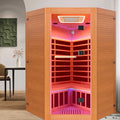
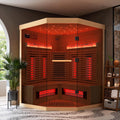
- 2-3 Person Indoor Infrared Sauna ($2,877.81): a pentagonal corner design with 9 panels and 360° surround heating, plus red light, ambient lighting, and dual Bluetooth speakers. Best for couples who want to share sessions.
- 3-4 Person Corner Infrared Sauna ($2,845.66): hemlock construction with Himalayan salt panels, 6 heating tubes, 3 carbon plates, and panoramic tempered glass. Best for a dedicated wellness corner.
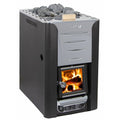
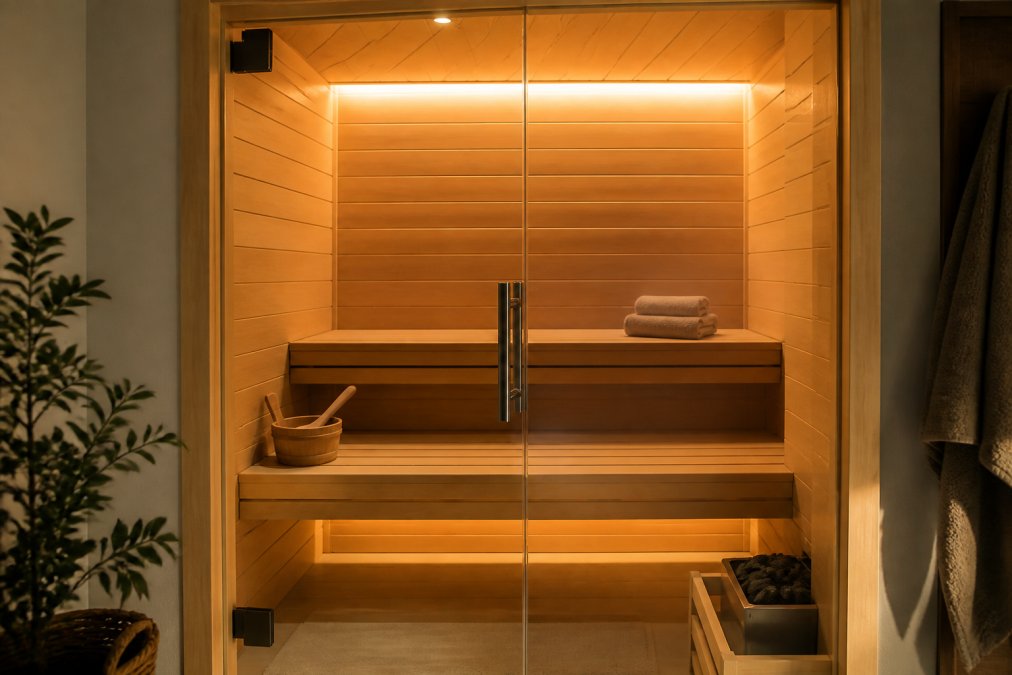
- Canadian Hemlock Traditional Indoor Sauna ($5,299.00): seats 4-6 with a UL-certified Harvia heater and a 60-minute shut-off timer. Best for anyone who wants authentic Finnish steam.
- 6-Person Barrel Sauna ($6,259.00): indoor or outdoor, built from certified reforested hemlock with a 6000W ETL-certified heater, volcanic rocks, and a front porch. Best for backyard entertaining.
Frequently Asked Questions
Is Canadian Hemlock good for a sauna?
Yes. Canadian hemlock is a closed-grain softwood that holds heat well, resists warping under repeated heating and cooling cycles, and carries no strong aroma. It is hypoallergenic and emits a light, pleasant scent, which suits people who find cedar's aromatic oils overpowering.

What are the downsides of hemlock wood in a sauna?
Hemlock lacks cedar's natural rot-resistant oils. It also darkens gradually with UV and heat exposure, shifting from pale cream to a warmer honey tone. Neither issue affects structural stability indoors.
How does Canadian Hemlock perform under high heat and humidity?
Hemlock's closed grain limits moisture absorption, which reduces swelling and contraction as the cabin cycles between hot and cool. In traditional steam saunas, that stability keeps bench slats and wall boards from cupping over time. A kiln-dried hemlock cabin paired with a 4.5 kW UL-certified heater reaches its working range and holds temperature evenly across the room.
What maintenance is required for a Canadian Hemlock sauna?
Wipe benches with a damp cloth after sessions, leave the door and vents open to dry the cabin. Avoid harsh cleaners, which strip natural finishes and dull the wood grain. Indoor hemlock cabins need very little beyond ventilation and an occasional light sanding of high-touch areas.