Cedar vs Hemlock Sauna Durability: Which Wood Lasts?
Table of Contents
- Cedar vs Hemlock Sauna Durability: The Short Answer
- Rot, Decay, and Moisture Resistance Compared
- Heat Retention, Thermal Expansion, and Structural Stability
- Aroma, Aromatic Compounds, and Indoor Air Quality
- Sauna Wood Maintenance Tips for Cedar and Hemlock
- How to Size a Sauna for Your Family
- Cost, Longevity, and Sustainability Compared
- Frequently Asked Questions
Last Updated: October 2, 2026
Cedar vs Hemlock Sauna Durability: The Short Answer
Cedar and hemlock both hold up well in sauna conditions, but hemlock sauna durability and cedar's fail in different ways. Cedar resists moisture and insects thanks to natural oils, while hemlock relies on density and a tight grain to resist warping. Short version: cedar wins on rot resistance and aroma, hemlock wins on cost and thermal stability. This guide from Luxure Saunas breaks down how each wood performs so you can pick the right one.
Rot, Decay, and Moisture Resistance Compared
Cedar resists rot and decay better than hemlock because its natural oils and tannins repel moisture and insects. Hemlock has no such oils, so it depends on tight grain and ventilation to stay dry. Both last for years in a well-built sauna, but cedar forgives a damp climate more readily.
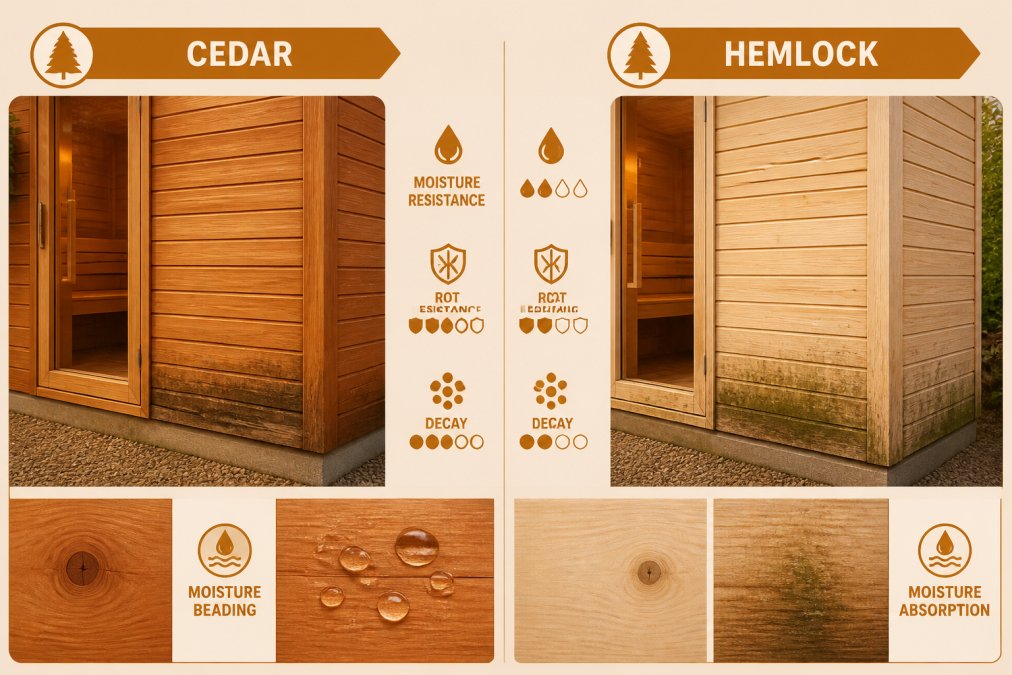
- Cedar: natural oils and tannins resist moisture, mold, and insects
- Hemlock: dense grain resists warping but has no natural oil protection
- Both: need airflow and drainage to avoid standing water at the base
Heat Retention, Thermal Expansion, and Structural Stability
Heat retention is mostly an insulation and mass problem, not a species problem. Wood is a poor conductor either way, cedar and hemlock sit in a similar range, roughly 0.08 to 0.11 W/m·K depending on density and moisture content. Wall thickness, insulation behind the tongue-and-groove, and heater placement move the needle far more than species.
- Hemlock is the denser of the two (roughly 28-30 lb/ft³ at 12% moisture content versus cedar's 22-24 lb/ft³ for most Western red cedar grades). Higher density means a lower equilibrium moisture content swing for the same ambient change, so hemlock boards cup and bow less across repeated heat cycles.
- Cedar has a higher tangential-to-radial shrinkage ratio, so flat-sawn cedar boards move more visibly than flat-sawn hemlock when the room goes from cold-and-damp to 190°F. Quarter-sawn or vertical-grain cedar narrows that gap considerably.
- Both woods stabilize once they reach equilibrium with the sauna's operating humidity. The first 30-60 heat cycles are when most movement happens; after that, boards settle.
A few practical numbers before you frame a wall:
| Factor | Cedar | Hemlock |
|---|---|---|
| Typical installed board thickness | 1×4 or 1×6 T&G, ~11/16 in. finished | Same |
| Recommended stud spacing for 1×6 T&G | 16 in. on center | 16 in. on center |
| Expansion gap at panel ends | 1/8 in. minimum | 1/8 in. minimum |
| Time to reach stable moisture content in service | 4-8 weeks of regular use | 4-8 weeks of regular use |
Indoor vs. Outdoor: Two Different Durability Problems
Most comparisons skip this: an indoor sauna and an outdoor barrel or cabin sauna put the wood under completely different stress profiles, and the cedar-vs-hemlock answer changes with the installation.

- Raise the structure at least 4 in. off any concrete or soil contact.
- Use a roof overhang or a full roof; do not rely on the wood alone.
- Leave a drainage gap behind the exterior cladding.
- Re-coat any exterior-facing hemlock with a breathable, exterior-rated finish every 2-3 years. Never finish the interior.
What Actually Drives Structural Fatigue
Long-term structural fatigue comes from three sources, in order:
- Moisture cycling at the base and around the door. This is where 80% of real-world failures start, regardless of species.
- Fastener corrosion. Stainless steel fasteners are non-negotiable in a wet sauna; galvanized or plain steel will fail and stain the wood long before the wood itself fails.
- Thermal expansion at panel joints. Barrel saunas with steel bands are the most sensitive here, bands loosen as the staves shrink and swell, and need re-tensioning seasonally.
Species choice affects your margin when one of those three goes wrong. Cedar gives more margin outdoors; hemlock gives more on dimensional stability indoors. Neither saves a sauna with a wet base and mild-steel screws.
Aroma, Aromatic Compounds, and Indoor Air Quality
Cedar releases aromatic compounds that give it the classic sauna scent, while hemlock has a lighter, milder aroma. Both are considered hypoallergenic, and neither should produce harmful VOC emissions when left unfinished.
Sauna Wood Maintenance Tips for Cedar and Hemlock
The universal rule: keep the wood dry between sessions and never seal the interior with a film-forming finish. Stain, varnish, polyurethane, and most oil blends trap moisture and off-gas when heated. Leave the interior bare, clean with a damp cloth, air the room out after every session, and inspect the lower wall and floor for dampness.
Baseline Routine (Both Species, All Climates)
- Wipe benches and walls with a damp cloth after each session, no soap, no cleaner
- Leave the door and vents open for 20-30 minutes after use to flush humid air
- Inspect the base, lower wall, and door threshold monthly for moisture or discoloration
- Sand lightly with 120-150 grit if the surface roughens, then leave it bare
- Check fasteners and (on barrels) band tension twice a year
Cedar-Specific Protocols
Cedar's natural oils are its defense, and they fade with heat and time. You cannot replenish them without sealing the wood, which you should not do on the interior. What you can do:
6-Person Indoor/Outdoor Barrel Sauna →
- Interior: nothing beyond the baseline. Cedar's extractives keep working as long as the wood stays dry between sessions.
- Exterior (outdoor saunas): an exterior-rated, breathable finish on the outside faces only, reapplied every 2-3 years. Never carry that finish onto the interior side of the same board.
- Watch for: cedar's aroma fading is normal and not a sign of degradation. Aroma loss and rot resistance are related but not identical, the wood can still be rot-resistant after the scent quiets down.
Hemlock-Specific Protocols
Hemlock has no natural oil protection, so it depends entirely on detailing and drying. Maintenance is less about products and more about airflow:
- Interior: baseline routine, plus a monthly check of the lower 12 in. of wall and the floor perimeter. Hemlock shows moisture problems as dark streaks or a musty smell before visible mold appears.
- Exterior: hemlock needs a breathable exterior finish on all weather-exposed faces, reapplied every 2-3 years. Skipping this in a wet climate is the single most common cause of premature hemlock failure.
- Watch for: surface mold on shaded exterior faces. It is cosmetic if caught early, clean with a diluted vinegar solution, let it dry fully, and fix the airflow or drainage issue that caused it.
Climate-Specific Protocols
Humid and coastal climates. Cedar earns its premium here, and hemlock needs the most attention. Raise any structure at least 4 in. off ground contact, keep a drainage gap behind exterior cladding, and run the heater an extra 15-20 minutes after the last session to drive moisture out of the walls. For hemlock, add a quarterly inspection of the base and any north- or east-facing exterior wall.
How to Size a Sauna for Your Family
Sizing a sauna comes down to bench space, not headcount alone. Plan roughly two feet of bench per seated adult, then add one seat of buffer so the room never feels cramped when everyone shows up at once.
| Household Use | Recommended Capacity | Typical Footprint |
|---|---|---|
| 1-2 daily users | 3-4 person | Compact indoor corner |
| 3-4 daily users | 6 person | Barrel or cabin |
| Frequent guests | 6-8 person | Full barrel or 8-person room |
Cost, Longevity, and Sustainability Compared
Hemlock costs less up front and lasts decades with good care, while cedar costs more and resists decay longer in harsh conditions. Both are renewable softwoods, and hemlock is often sourced from certified reforested stands, keeping its footprint low.
Cedar wins on rot resistance and aroma. Hemlock wins on cost and stability. The right pick depends on your climate and how often you plan to use the sauna, not on which wood is "better" in the abstract.
Frequently Asked Questions
Is hemlock better than cedar for a sauna?
Neither wins outright. Hemlock sauna durability is strong for indoor builds because the wood resists warping and decay and holds heat well, and it costs less. Cedar brings natural oils and aromatic compounds that help with rot and mildew resistance in damp outdoor settings, plus a lighter weight. Match the wood to where the sauna sits and how often it gets wet, not to a general ranking.
Is hemlock as durable as cedar for outdoor saunas?
Cedar has an edge outdoors because its natural oils and tannins slow rot and mildew in wet, humid conditions. Hemlock holds up well when the exterior is finished and the sauna has proper ventilation, as on the 6-Person Indoor/Outdoor Barrel Sauna built from Canadian-certified reforested hemlock. Expect cedar to tolerate neglect longer, and hemlock to perform well with regular care.
What are the maintenance differences between cedar and hemlock saunas?
Cedar needs less frequent treatment because its oils resist moisture and insects, so an annual inspection and light cleaning often suffice. Both need ventilation after each session, a wipe-down of benches, and a check of the wood grain for cracks or resin buildup.
How does cedar wood hold up to high heat and humidity?
Cedar handles the heat and steam cycles of a traditional sauna well. Its low density limits thermal expansion and warping, and its oils slow the mold and mildew growth that constant humidity encourages. The main trade-off is softening of the wood surface over many years, which is cosmetic rather than structural. Knot-free grades hold their shape best over a long lifespan.
How long do cedar and hemlock saunas last?
An indoor cedar sauna that stays dry between sessions can run 15 to 20 years or more, and outdoor cedar with a finished exterior and a roof lasts a similar span. Hemlock sauna durability indoors is comparable when humidity is managed. Outdoors, hemlock typically needs more attentive maintenance to reach the same lifespan, which is why roof coverage and ventilation matter as much as the wood itself.
Choosing between cedar and hemlock is really a question about your climate, your budget, and how you plan to use the room. Luxure Saunas builds both, with handpicked traditional, infrared, and barrel saunas crafted from premium Canadian hemlock and cedar, plus consistent heating, integrated Himalayan salt panels, and customizable ambient lighting. Get started with Luxure Saunas and find the sauna built to last in your space.