Buy Premium Infrared Sauna Online: 2026 Review Guide
Table of Contents
- Why Buy Premium Infrared Sauna Online in 2026
- Top Picks: Premium Infrared Saunas Compared
- Infrared Sauna Health Benefits: What the Research Says
- Sauna Wood Types: Cedar vs Hemlock
- How to Install a Home Infrared Sauna: Electrical and Assembly Guide
- Maintenance and Long-Term Care for Your Premium Infrared Sauna
- Conclusion: Which Premium Infrared Sauna Is Right for You?
- Frequently Asked Questions
Last Updated: September 27, 2026
Why Buy Premium Infrared Sauna Online in 2026
Shopping for a premium infrared sauna online lets you compare heating systems, wood grades, and electrical requirements before a four-figure purchase. This guide covers our four most-recommended models, full-spectrum versus far-infrared heat, and the installation details most listings bury.

Cleveland Clinic overview of sauna health effects
Top Picks: Premium Infrared Saunas Compared
Each model solves a different problem: solo sessions, couples, corner spaces, and backyard placement.
| Model | Capacity | Heating | Power | Price | Best For |
|---|---|---|---|---|---|
| 1-Person Full-Spectrum | 1 person | 7 panels + red light | 1290W / 120V | $1,645.66 | Solo indoor use |
| 2-3 Person Indoor | 2-3 people | 9 panels, 360° | 2180W / 110V | $2,877.81 | Couples, corner rooms |
| 3-4 Person Corner | 3-4 people | 6 tubes + 3 carbon plates | 220V | $2,845.66 | Families, salt therapy |
| 4-Person Outdoor | 4 people | 8 far-infrared panels | 2100W / 110-120V | $4,453.91 | Backyards, patios |
1-Person Indoor Full-Spectrum Infrared Sauna with Red Light Therapy
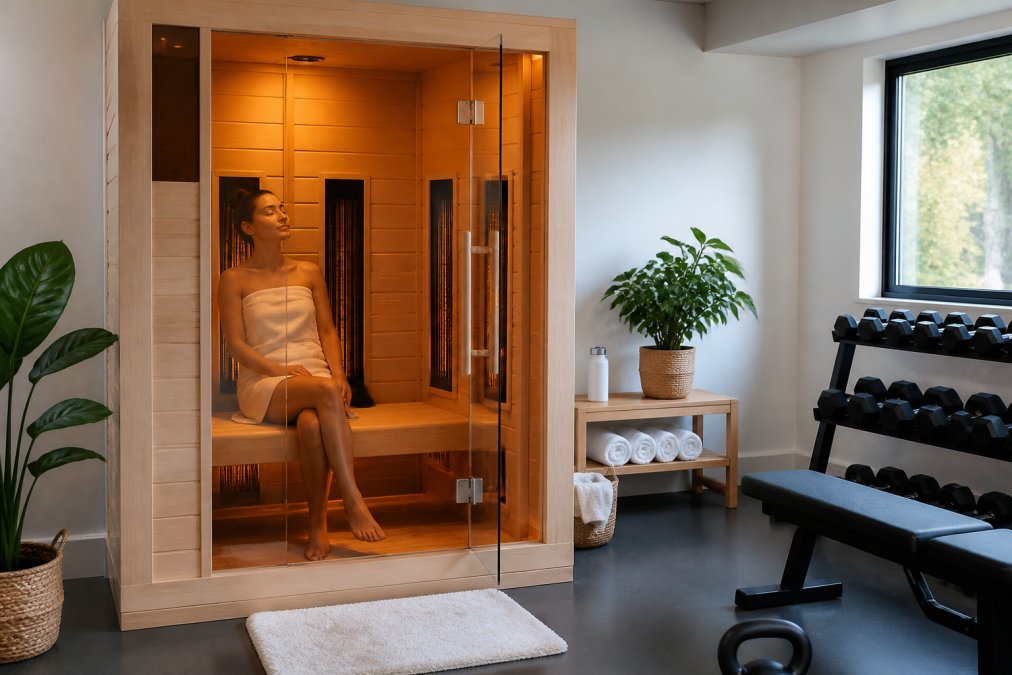
The smallest unit is the most feature-dense per square foot, packing 7 infrared heating panels with 140 LED beads split between 660nm red light and 850nm near-infrared light.

2-3 Person Indoor Infrared Sauna with 9 Heating Panels
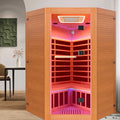
For couples or anyone who wants room to stretch, the 2-3 person pentagonal corner model is the practical middle ground. Nine far-infrared panels deliver 360° surround heating across a stated 3-1000 micron wavelength range.
3-4 Person Corner Infrared Sauna with Himalayan Salt Panels
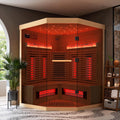
This is the model for buyers who want the full ritual: Canadian Hemlock construction, 8mm tempered glass, and Himalayan salt panels alongside 6 heating tubes and 3 carbon plates.
4-Person Outdoor Far Infrared Sauna Room
The only outdoor model is built for year-round backyard use. Old Fir construction and a waterproof exterior stand up to weather, while 8 far-infrared panels push 2100W across a 25°C to 60°C range.
Infrared Sauna Health Benefits: What the Research Says
Infrared sauna health benefits are real, but the marketing around them is not. Infrared cabins are a comfort and recovery tool with a plausible cardiovascular upside, not a disease treatment. Here is what the evidence supports, and who should not buy one.

What the research supports
- Relaxation and perceived stress relief. The most consistently reported benefit: a 20 to 30 minute session raises skin temperature and triggers the same post-heat calm as a warm bath.
- Muscle recovery and perceived soreness. Athletes use infrared cabins after training for the same reason they use hot tubs: heat increases blood flow to tissue. The effect is modest and cumulative, not dramatic after one session.
- Cardiovascular and circulation support. Sauna use has been studied for its effect on heart rate and blood vessel function, but the research is more mature for traditional Finnish saunas than infrared cabins, treat infrared cardiovascular claims as promising, not proven.
- Sleep quality. Anecdotally strong, especially when sessions end 60 to 90 minutes before bed, thanks to the post-session core temperature drop that mimics natural pre-sleep cooling.
What most guides miss is that session length and consistency matter more than maximum temperature. A 20 to 30 minute session four or five times a week beats one long weekly sweat; stress and sleep improve with routine, not intensity.
Harvard Health discussion of sauna use and cardiovascular effects
Who should not use an infrared sauna
This is the section almost no competitor writes, and it matters most before you spend four figures. Infrared cabins run cooler than traditional saunas but still raise core body temperature, that is the risk vector.
Talk to your doctor before buying if you:
- Have a heart condition, arrhythmia, or uncontrolled blood pressure
- Are pregnant or trying to conceive
- Take medication that affects sweating, blood pressure, or heart rate, including diuretics, beta blockers, and some antidepressants
- Have diabetes, especially with neuropathy that reduces your ability to feel heat
- Have a history of heat intolerance, fainting, or low blood pressure on standing
- Are recovering from recent surgery or have an open wound
Do not use an infrared sauna if you:
- Are under the influence of alcohol or recreational drugs
- Have an acute infection with fever
- Are alone and have a known seizure disorder
How to get the most from a session
- Hydrate first. Drink 8 to 16 ounces of water in the hour before you start.
- Start at 100°F to 120°F for your first week, then work up. The 1-person full-spectrum model tops out around 149°F, but you do not need to live there.
- Cap sessions at 20 to 30 minutes. Longer is not better.
- Cool down gradually. Step out, sit five minutes, then shower, jumping into a cold shower is a cardiovascular stressor, not a wellness hack.
- Skip a day if you feel lightheaded. Heat stress compounds.
If you have any of the conditions above, get clearance from your physician before you order, not after the crate arrives.
Sauna Wood Types: Cedar vs Hemlock
Cedar and hemlock dominate this category, and the choice comes down to aroma versus stability. Cedar carries a natural scent and resists moisture well, which is why it dominates traditional builds. Hemlock is denser, holds its shape across temperature swings, and costs less for the same structural quality.
1-Person Indoor Full-Spectrum Infrared →
How to Install a Home Infrared Sauna: Electrical and Assembly Guide
Installation splits into two jobs: getting power to the right spot and assembling the cabin. Most indoor units assemble in under an hour with numbered parts; the electrical work is where buyers get caught out.
Step 1: Match the unit to your circuit
The most common pre-purchase mistake is buying a 220V cabin for a home with only 120V outlets in the target room. Check the spec sheet before you check out.
| Unit type | Voltage | Typical draw | Circuit needed |
|---|---|---|---|
| 1-person full-spectrum | 120V | 1290W (~11A) | Standard 15A dedicated outlet |
| 2-3 person indoor | 110V | 2180W (~20A) | 20A dedicated circuit recommended |
| 3-4 person corner | 220V | 2200W+ | Dedicated 220V line, 20A breaker |
| 4-person outdoor | 110-120V | 2100W (~19A) | 20A dedicated outdoor GFCI outlet |
Step 2: Check your breaker panel before you order
Open the panel and count spare slots. A 220V sauna needs a double-pole breaker, which occupies two slots. If your panel is full, the electrician will need a tandem breaker or subpanel, budget for that.
Take a photo of your open breaker panel and the outlet you plan to use, then send both to the sauna manufacturer's support team before ordering. Most will confirm in writing whether your setup will work. That email is your protection if the unit arrives and does not power on.
Step 3: Understand what an electrician actually does
For a 220V install, expect the electrician to:
- Run a dedicated circuit from the panel to the sauna location
- Install a double-pole breaker sized to the unit's draw
- Terminate at a junction box or a NEMA 6-20 or 6-15 receptacle
- Test the circuit under load before signing off
A run in an unfinished basement or garage is a half-day job; a finished-wall run through a second floor is a full day and costs more. Get two quotes and ask whether the price includes the breaker and receptacle or just labor.
Step 4: Site prep and assembly
- Measure the footprint plus clearance for the door swing, most doors need 24 to 30 inches of swing room
- Verify the floor is level and can bear the unit's weight; a filled 4-person cabin plus occupants can exceed 1,500 lbs
- Confirm the ceiling height clears the cabin's tallest panel, most indoor units run 75 to 80 inches
- For outdoor units, pour or place a level pad and confirm the power run is weather-rated and GFCI-protected
- Assemble on the pad or floor, not in the hallway, the panels are heavy and awkward to move once partially built
- Power on with the unit empty and the timer set to 10 minutes before your first session
Step 5: First-run checklist
If you rent, or your panel cannot support the load, the 120V models in this guide are the practical path, they plug into a standard dedicated outlet and skip the electrician entirely.
Maintenance and Long-Term Care for Your Premium Infrared Sauna
Long-term care is simple but easy to skip. Wipe benches and backrests with a damp cloth after each session, leave the door open 15 to 20 minutes to let moisture escape, and vacuum the heater panels monthly with a soft brush attachment.
Conclusion: Which Premium Infrared Sauna Is Right for You?
Matching the cabin to your space and wiring matters more than chasing the highest panel count. Solo buyers should look at the 1-person full-spectrum model, couples at the 2-3 person corner unit, families at the 3-4 person salt-panel cabin, and outdoor owners at the weatherproof 4-person room.
Frequently Asked Questions
What features define a premium infrared sauna?
A premium infrared sauna typically includes full-spectrum or far-infrared heating panels, low-EMF technology, high-quality wood like Canadian hemlock or cedar, and extras such as red light therapy, Bluetooth audio, and Himalayan salt panels. Look for models with 6 or more heating panels, digital controls, and clear electrical specifications. Luxure Saunas offers options like the 1-Person Full-Spectrum model with 7 panels and 660nm/850nm red light, starting at $1,645.66.
Are there specific electrical requirements for premium home saunas?
Yes. Most indoor infrared saunas run on 120V and require a dedicated 15-amp outlet, while larger models may need 220V or 110-120V with a 20-amp plug. For example, the 1-Person Full-Spectrum sauna uses a standard 15-amp, 120-volt plug, while the 3-4 Person Corner model specifies 220V. Always check your home's wiring and consult an electrician if you're unsure about available voltage.
What is the downside to an infrared sauna?
Infrared saunas operate at lower temperatures than traditional steam saunas, so some users miss the intense heat. They also require dedicated indoor space or a weatherproof outdoor area, and higher-end models represent a significant investment. Additionally, those with certain health conditions should consult a doctor before use. Proper installation and maintenance are essential to avoid electrical issues or wood damage over time.
Is it safe to buy a high-end sauna online?
Buying a high-end sauna online is safe when you purchase from a reputable brand that provides detailed specifications, warranty information, and clear return policies. Look for real product photos, verified customer reviews, and transparent pricing. Luxure Saunas, for instance, lists exact dimensions, voltage requirements, and assembly instructions for each model, so you know what to expect before delivery.
How do I verify the quality of infrared heating elements?
Check the number and type of heating panels. Premium saunas often use carbon heating panels or ceramic heaters, with 6 to 9 panels for even heat distribution. Full-spectrum models may include near, mid, and far-infrared wavelengths. Look for low-EMF claims and specific temperature ranges. For example, the 2-3 Person Indoor sauna has 9 far-infrared panels with a 3-1000 micron wavelength range and 360° surround heating.